How Long Does Spray Foam Insulation Last?
Properly installed spray foam lasts 80+ years — longer than most houses. Here's what drives longevity, what can shorten it, and what warranties actually cover.
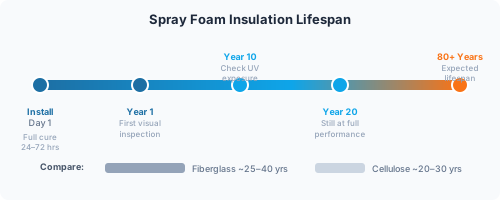
Properly installed spray foam insulation lasts 80 years or more. That figure comes from material testing, not marketing. Spray polyurethane foam (SPF) is a thermoset polymer — once it cures, the chemical bonds are stable. The foam doesn't compress, settle, or lose R-value the way fiberglass batts do over decades.
That "80+ years" number comes with conditions, though. Here's what actually drives spray foam lifespan, what can cut it short, and how to evaluate foam that's already in your walls or attic.
What Determines Spray Foam Lifespan?
Three things matter: installation quality, UV exposure management, and protection from sustained moisture.
**Installation quality is the biggest variable by far.** Spray foam mixed at incorrect ratios — from equipment calibration drift, temperature problems, or operator error — can look fine on day one and fail within 5–10 years. Off-ratio foam doesn't fully cure. It stays brittle or tacky, loses adhesion to the substrate, and can crumble when disturbed. There's no non-destructive test to check for off-ratio cure after the foam is installed, which is why the contractor's equipment calibration and technique matters enormously.
A well-installed job from a reputable contractor will outlast the house. Off-ratio foam from a cut-rate installer can be a $3,000–$8,000 remediation problem.
**Substrate preparation.** Foam applied to dirty, wet, or frost-covered surfaces can delaminate — physically separate from the framing or concrete it was applied to. Delamination is the most common early-life failure mode, and it's almost always a prep or temperature issue, not a material defect. The Spray Polyurethane Foam Alliance (SPFA) requires a minimum substrate temperature of 50°F for application. Get your contractor's minimum temperature policy in writing before they schedule the job.
**Moisture exposure type.** Closed-cell foam is highly moisture-resistant; open-cell is not. Application in the right environment for the right foam type matters for long-term performance. More on this below.
Open-Cell vs. Closed-Cell: Do They Last the Same?
Both types are chemically stable after cure — but they perform differently in challenging environments.
**Closed-cell spray foam** (2-lb density) is rigid, dense, and essentially waterproof. Its resistance to liquid water makes it appropriate for crawl spaces, basements, and any below-grade application. It doesn't absorb moisture and won't support mold growth on its own surface. Mechanical properties of closed-cell foam actually increase slightly over the first few years as the blowing agents finish off-gassing and the cell walls stabilize.
**Open-cell spray foam** (0.5-lb density) is softer and vapor-permeable. In a protected interior application — attic rafter bays, interior wall cavities — it lasts as long as the structure. In a high-moisture application, repeated wet/dry cycles can degrade the open-cell foam structure over decades. Open-cell exposed to liquid water consistently is not appropriate — it will saturate and eventually fail.
Both types carry lifetime material warranties from major manufacturers including Icynene (now Huntsman), BASF, Covestro, and Johns Manville, when properly installed by a certified applicator.
Choosing the wrong type for the application is the fastest way to cut lifespan dramatically. See the [open-cell vs. closed-cell guide](/open-cell-vs-closed-cell-spray-foam) for a full comparison on which applications need which foam.
UV Exposure: The Main Enemy of Foam
Spray polyurethane foam degrades quickly when exposed to ultraviolet light. UV breaks down the polymer chains in the foam surface, causing yellowing, surface chalking, crumbling, and eventually structural failure of the exposed layer.
In direct sunlight, the degradation timeline looks like this:
- **6–12 months:** Visible yellowing and slight surface texture change
- **1–3 years:** Surface chalking and some friability in the outer 1/4 inch
- **3–5 years:** Significant surface degradation; delamination possible in the exposed zones
- **5–10 years:** Foam surface essentially destroyed; underlying layers intact but exposed
The key phrase: "in direct sunlight." Foam that is covered — by drywall, plywood, rigid board, or any approved thermal barrier — won't see UV exposure and will last 80+ years.
The code requirement under IRC R316 is that spray foam in occupied or accessible spaces must be covered by a thermal barrier — minimum 1/2-inch gypsum board. This rule exists primarily for fire resistance (foam is combustible), but it also conveniently provides permanent UV protection.
In attic applications where foam is applied to the roof deck underside, it must be either covered with gypsum board or specified as an "ignition-barrier-compliant" product. Verify with your contractor which specification they're using. Foam left bare in an attic — even one without windows — can receive enough scattered UV through a roof hatch or ventilation gap to degrade over years.
Signs That Spray Foam Is Failing
If you've got existing spray foam and you want to evaluate its condition, look for these indicators:
**Yellowing or orange-brown discoloration.** Some color change from white or cream to light yellow is normal aging for both foam types and doesn't indicate failure. Orange-brown discoloration on exposed surfaces signals UV degradation.
**Surface crumbling or powdering.** Touch a small area — properly cured foam shouldn't leave powder on your fingers. Friable foam either had UV exposure or was off-ratio during installation.
**Visible gaps between foam and substrate.** Delamination allows air infiltration to resume at the failure point. In a rim joist, a 1/4-inch gap can allow as much air movement as no insulation at all.
**Persistent chemical odor.** Cured SPF has no odor 48–72 hours after application. A chemical smell weeks or months after installation indicates uncured components still off-gassing — a sign of off-ratio foam.
**Soft or compressible areas in closed-cell foam.** Closed-cell foam should feel rigid. Soft spots indicate either moisture infiltration (from a leak behind the foam) or off-ratio installation.
If you're buying a house with spray foam insulation and can't verify the installer or materials, an energy auditor with SPF experience can inspect the foam as part of a pre-purchase assessment. It's worth the $300–$500 inspection fee on a home where spray foam is a selling point.
Does Spray Foam Need Maintenance?
Under normal conditions, no. That's one of its genuine advantages. It doesn't settle like blown-in cellulose, doesn't need annual checking like batt insulation that can shift or fall out, and doesn't absorb pests the way straw-based products do.
A few situations do call for attention, though:
**Water intrusion from leaks.** Open-cell foam that gets saturated from a plumbing or roof leak needs to fully dry before you close the area. Open-cell foam staying wet for extended periods won't mold on its own surface — SPF doesn't provide nutrients for mold growth — but it keeps the wooden substrate behind it damp, which does support mold growth. Get to 19% or below wood moisture content before closing up.
**Rodent damage.** Rodents chew through both open-cell and closed-cell foam. Spray foam is not a pest barrier. If you have a rodent history in your crawl space or attic, pair the foam with mechanical exclusion: hardware cloth over penetrations, metal flashing at the foundation top, steel wool in larger gaps.
**Renovation cuts.** When you cut into foamed walls or ceilings to run new wiring or plumbing, you expose the cut edges. Fill those cut surfaces with new spray foam or cover them with an appropriate barrier. Don't leave open-cell foam edges exposed in a high-humidity environment.
**Thermal barrier damage.** If the gypsum board covering attic spray foam gets damaged by water or impact, replace it. The foam behind it is still fine — but exposed foam without its thermal barrier is a fire and UV problem.
Warranty Coverage: What to Expect from Contractors
Major manufacturer warranties cover the product itself — typically R-value performance for the life of the structure and adhesion failure due to material defects. These are strong warranties on paper.
What manufacturer warranties **don't** cover:
- Off-ratio installation (that's contractor liability, not manufacturer)
- UV damage from failure to install required thermal barrier
- Physical damage from water leaks or pests
- Normal surface discoloration
Contractor workmanship warranties vary widely. The good ones offer 10-year workmanship warranties covering adhesion, application defects, and off-ratio failures. Most contractors offer 1–2 years. Some offer nothing in writing at all — walk away from those bids.
Before work begins, get:
1. The manufacturer's product name and warranty documentation
2. Proof the contractor is SPFA-certified or state-licensed for SPF work
3. Written workmanship warranty with specific coverage terms
4. Proof of liability insurance and workers' comp
The warranty conversation also tells you about the contractor. A legitimate installer is confident in their work and won't hesitate to put terms in writing.
For a complete picture of what goes wrong during installation, the [spray foam insulation mistakes guide](/spray-foam-insulation-mistakes) covers every major failure mode with repair cost estimates.
Before you hire, [see what your project will cost](/spray-foam-insulation-cost-calculator) for your specific application and area. Knowing the fair price range makes it easier to filter out bids that are suspiciously low.
For context on how spray foam compares to insulation products that do wear out sooner, the [spray foam vs. fiberglass guide](/spray-foam-vs-fiberglass-insulation) covers lifespan, R-value retention, and cost comparison.
For more on how we verify the cost data behind the calculator, see our [about page](/about).