Open-Cell vs Closed-Cell Spray Foam: Which?
Open-cell foam costs half as much but performs differently under moisture and cold. Here's how to pick the right foam for your specific job.
The most common question contractors hear from homeowners before a spray foam job: "Which type do I need?" It's a fair question, and the honest answer is — it depends on where you're putting it and what you're trying to achieve.
Both foams air-seal. Both reduce heat transfer. But they do it differently, they cost differently, and they fail differently when the wrong one gets specified. Here's what actually separates them.
The Chemistry Behind Each Foam Type
Spray polyurethane foam (SPF) forms when two liquid components — an isocyanate (the A-side) and a polyol resin blend (the B-side) — mix at the spray gun and react. The reaction generates heat and causes the mixture to expand.
**Open-cell foam** expands aggressively — up to 100 times its liquid volume. That expansion creates a soft, spongy structure where the cells break open as they form. Air fills those open cells. Density lands around 0.5 lb per cubic foot. The result feels like a firm sponge: flexible, permeable to water vapor, and relatively lightweight.
**Closed-cell foam** uses a blowing agent (typically an HFO compound like Honeywell's Solstice) that inflates closed cells — the cell walls stay intact and trap the blowing agent inside. The density is 2 lb per cubic foot, four times heavier. It's rigid, hard to the touch, and almost impermeable to moisture.
That structural difference drives every downstream comparison: R-value, vapor control, cost, and application suitability.
R-Value: Open-Cell vs Closed-Cell by Thickness
Closed-cell wins on R-value per inch, and it's not close.
Open-cell foam delivers approximately **R-3.7 per inch** of thickness. Closed-cell delivers **R-6.0 to R-6.5 per inch**, depending on the product and blowing agent used. The International Residential Code (IRC) recognizes R-6.0 per inch as the minimum for closed-cell products under Section R402.
Here's what that means in practice for a 2×6 wall cavity (5.5 inches of space):
| Foam Type | Thickness | R-Value Achieved |
|-----------|-----------|-----------------|
| Open-cell | 5.5" (full fill) | ~R-20 |
| Closed-cell | 3.0" (partial fill) | ~R-18 |
| Closed-cell | 5.5" (full fill) | ~R-33 |
If you have limited depth — say, a 2×4 wall with only 3.5 inches — closed-cell gets you to R-21 where open-cell only reaches R-13. That's significant in cold climates where wall R-value targets are R-20 or higher.
[See what your project will cost](/spray-foam-insulation-cost-calculator) at different foam types and thicknesses before you commit to either approach.
Moisture, Vapor Barriers, and When It Matters
Open-cell foam has a vapor permeance of roughly **10–16 perms** at standard thickness. That makes it a Class III vapor retarder at best — essentially permeable. In humid climates (ASHRAE Climate Zones 1–4), that permeability is acceptable or even desirable for wall assemblies because moisture can dry toward the interior.
Closed-cell foam at **2 inches** achieves a permeance of about **0.8 perms**, which meets the definition of a Class II vapor retarder under IRC Section R702.7. At 3 inches, it's closer to **0.5 perms** — approaching a true vapor barrier.
This matters enormously in two scenarios:
**Cold climates (Zones 5–8):** A wall assembly with interior poly sheeting and open-cell foam can trap moisture because moisture migrating outward from the heated interior hits the cold sheathing and condenses. Closed-cell on the interior face of the sheathing keeps the dew point outside the wall system. Building Science Corporation's research on this has been standard guidance since the early 2010s.
**Crawl spaces and below-grade walls:** Concrete and masonry wick moisture. Open-cell foam on a foundation wall will eventually absorb that moisture and can foster mold growth. Closed-cell is the correct choice for any ground-contact application.
In moderate climates (Zones 3–4) with proper vapor management, open-cell performs fine in walls. Don't overbuild for a problem your climate doesn't create.
Cost Comparison: Installed Price Per Square Foot
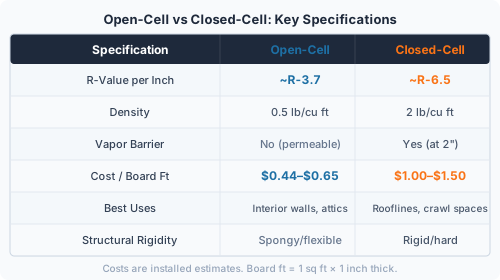
Open-cell installed runs **$1.00 to $1.50 per square foot** at typical thicknesses (3.5 to 5.5 inches). Closed-cell runs **$2.50 to $3.50 or more per square foot** at typical thicknesses (2 to 4 inches).
Worked example: **800 sq ft of crawl space walls** (vertical application on foundation walls, 3 feet tall):
- Open-cell at 3" — not recommended here, but hypothetically: $1.20 × 800 = **$960**
- Closed-cell at 2" (R-12, minimum for below-grade): $2.75 × 800 = **$2,200**
- Closed-cell at 3" (R-19, preferred): $3.00 × 800 = **$2,400**
That's a $1,440 difference for the right call. [Plug in your area and foam type](/spray-foam-insulation-cost-calculator) to model your specific numbers.
The cost gap narrows a bit when you account for thickness needed to hit the same R-value. You need 8 inches of open-cell to match 3 inches of closed-cell. That extra material cost closes the gap slightly, but closed-cell is still more expensive in virtually every scenario.
Best Applications for Each Foam Type
**Open-cell is the right call for:**
- Interior wall cavities in Climate Zones 1–4
- Attic rafter bays where vapor control isn't the primary concern
- Soundproofing applications (open-cell absorbs sound better due to its porous structure)
- Budget-constrained projects where air sealing matters more than peak R-value per inch
**Closed-cell is the right call for:**
- Crawl space walls and floors
- Rim joists (every building scientist recommends closed-cell here)
- Exterior sheathing applications in cold climates
- Metal buildings and commercial roofing decks
- Any application with direct moisture or weather exposure
- Locations where you need structural rigidity (closed-cell adds measurable racking strength to wall panels)
The [about page](/about) covers how the calculator handles these distinctions when building estimates for different application types.
Can You Mix Open-Cell and Closed-Cell?
Yes, and it's more common than homeowners expect. Two scenarios come up regularly.
**The hybrid attic assembly:** A contractor sprays 2 inches of closed-cell directly on the roof deck for vapor control and initial R-value, then fills the remaining rafter depth with open-cell foam. This achieves vapor protection without the premium cost of full-depth closed-cell. You get approximately R-13 from the 2 inches of closed-cell and another R-18 to R-22 from the open-cell fill — total R-31 to R-35 in a 2×10 rafter cavity, for less money than all closed-cell.
**Crawl space plus walls:** Some contractors spray closed-cell on crawl space walls and under-slab areas, then switch to open-cell for the above-grade walls of the same structure. Each zone gets the foam type suited to its exposure.
There's no compatibility issue chemically — they're different products from the same A-side/B-side family, and they adhere to each other without problems. The main limitation is scheduling: two different foam types often mean two different crews or two separate days, which adds mobilization cost.
What you shouldn't do is try to substitute one for the other arbitrarily to chase a lower price. A contractor who suggests swapping closed-cell for open-cell in your crawl space to save money is not saving you money — they're moving the problem to a future repair bill.
Choose foam type based on the assembly, not the budget. Then [get a free estimate](/spray-foam-insulation-cost-calculator) to know what the right choice costs for your square footage.
What Contractors Won't Always Tell You
A few practical details that affect real-world performance but rarely appear in sales conversations.
**Ambient temperature during installation matters.** Both foam types require substrate and ambient temperatures above 50°F for proper cell formation and adhesion. Open-cell is more forgiving in moderate cold; closed-cell is pickier. A crew that rushes a job on a 45°F morning risks off-ratio foam — cells don't form correctly, R-value drops, and adhesion weakens. Ask your contractor what their minimum temperature policy is before you sign.
**Open-cell foam needs a vapor retarder in cold climates.** In Climate Zones 5 through 8, open-cell's high permeance (10 to 16 perms) is a problem in wall assemblies because it doesn't stop moist interior air from migrating toward the cold exterior sheathing. Building codes in these zones typically require either closed-cell foam or an additional interior vapor retarder (like kraft-faced batts or a polyethylene sheet). Some contractors miss this and install open-cell in cold-climate walls with no vapor management — creating a slow moisture problem that takes years to show up as rot or mold.
**Closed-cell foam needs to be trimmed flush in wall cavities.** When closed-cell expands in a stud bay, it can bow past the framing face and create an uneven surface that makes drywall installation difficult. A good contractor trims the foam flush before the drywall crew arrives. If this step is skipped, you'll see wavy drywall lines or hear about it from your drywall sub.
**Both foams require 24 hours of ventilation before re-occupancy.** The chemical reaction produces amines and isocyanates during the cure process. These aren't harmless. Building occupants should stay out for at least 24 hours after application, and the space should be ventilated continuously during that window.
None of these are reasons to avoid spray foam. They're reasons to hire a contractor who knows what they're doing and to [run the numbers for your job](/spray-foam-insulation-cost-calculator) so you can have an informed conversation with whoever you hire.
For more detail on foam performance in attic applications specifically, see the [spray foam attic insulation guide](/spray-foam-attic-insulation). Our [About page](/about) explains how cost estimates are calculated for both foam types.