Spray Foam for Crawl Spaces: Costs & Moisture
Crawl spaces need closed-cell spray foam on walls and rim joists, not fiberglass on the floor above. Here's the cost breakdown, thickness requirements, and moisture strategy.
Crawl spaces fail from moisture before they fail from heat loss. A wet crawl space drives up heating bills, yes — but it also rots floor joists, feeds mold spores into the living area through the subfloor gaps, and corrodes HVAC equipment running through the space. The insulation strategy here needs to solve both problems at once.
Before scheduling any work, [estimate your project cost](/spray-foam-insulation-cost-calculator) for your crawl space's actual wall area. Costs vary by whether you're doing walls only, rim joists, a full vapor barrier package, or all three.
Conditioned vs. Vented Crawl Space: Which to Build?
This is the foundational question, and every other decision follows from it.
A **vented crawl space** uses screened foundation vents to move outside air through. The idea — from building codes written decades ago — was that fresh air would carry moisture out. In most US climates, the opposite happens. Warm, humid summer air enters the vents, hits the cooler concrete walls and ground, and condenses. You end up with more moisture than a closed crawl space would ever have.
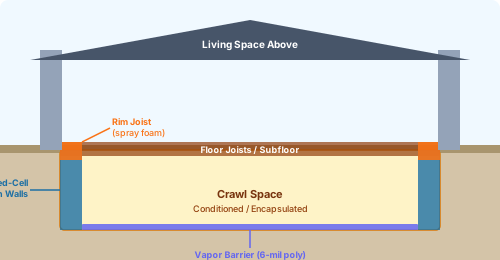
A **conditioned (unvented) crawl space** seals the vents, insulates the foundation walls and rim joists, and treats the crawl space as part of the home's thermal envelope. This is what the 2012 IECC and later versions require in most jurisdictions. Advanced Energy's research in North Carolina — conducted across hundreds of homes — found that closed crawl spaces had 50% lower relative humidity, lower HVAC operating costs, and significantly fewer wood moisture problems compared to vented designs.
If you're converting an existing vented crawl space, the process involves:
1. Blocking or sealing foundation vents
2. Spraying closed-cell foam on foundation walls and rim joists
3. Installing a heavy-duty vapor barrier on the floor (6-mil minimum, 20-mil preferred)
4. Adding a small HVAC supply register or dehumidifier to condition the space
Most states allow this conversion but require a permit. Pull the permit — it protects you at resale and verifies the installation meets code. For more on what happens when you skip the permit, see the [spray foam insulation mistakes guide](/spray-foam-insulation-mistakes).
Why Closed-Cell Is the Standard Choice
Open-cell foam has its uses, but not here.
Closed-cell foam at 2-lb density has a vapor permeance of 0.1 to 0.8 perms at 2 inches — that qualifies as a Class II vapor retarder under IRC R702.7. It does double duty: thermal insulation and moisture control in a single product. Rigid, water-impermeable, and bonded hard to the foundation wall.
Open-cell foam runs 5–15 perms. Water vapor passes straight through it. In a crawl space with any soil moisture or occasional water incursion, open-cell on foundation walls will absorb moisture, drop its effective R-value, and eventually support mold on the wooden elements behind or adjacent to it.
The closed-cell requirement is based on vapor physics, not upselling. If a contractor quotes open-cell for crawl space walls and can't give you a vapor management explanation, that's a red flag. The [open-cell vs. closed-cell guide](/open-cell-vs-closed-cell-spray-foam) covers the physics in more detail.
Spray Foam Crawl Space Cost Breakdown
Crawl space work costs more per square foot than typical wall applications because of access difficulty: low clearance, pipe and pier obstructions, and the need for better protective equipment in tight spaces.
**Foundation walls:**
A 1,500 sq ft footprint house typically has 18–36-inch foundation walls. At 24 inches of height, the perimeter wall surface runs 400–500 sq ft. At 2 inches of closed-cell (R-13):
- Material + labor: $2.50–$3.25 per sq ft
- Total for 450 sq ft: **$1,125–$1,465**
**Rim joists:**
The band joist on top of the foundation wall is often the single leakiest area in the building envelope. A 1,500 sq ft house has roughly 160–200 linear feet of rim joist. At 9 inches tall, that's about 135–150 sq ft.
- 2–3 inches of closed-cell on rim joists: $2.75–$3.75 per sq ft
- Total for 140 sq ft: **$385–$525**
**Vapor barrier (floor):**
Crawl space floors are not spray foamed — they get a mechanical barrier.
- 6-mil polyethylene: $0.10–$0.20 per sq ft installed
- 20-mil reinforced Class A barrier: $0.50–$0.90 per sq ft installed
- 1,500 sq ft floor: **$150–$1,350** depending on barrier spec
**Realistic total for a 1,500 sq ft home:**
- Walls + rim joists: $1,500–$2,000
- 20-mil floor vapor barrier: $750–$1,350
- Existing insulation removal (if needed): $300–$800
- **Full encapsulation package: $2,550–$4,150**
Regional variation matters. Northeast and West Coast contractors run 25–35% above national average. The Southeast, where crawl spaces are more common, tends to be competitive and closer to the low end.
[Run the numbers for your job](/spray-foam-insulation-cost-calculator) with your actual square footage and region to get a more precise estimate.
Thickness Requirements for Crawl Space Walls
The IECC 2021 specifies continuous insulation R-values for crawl space walls by climate zone. "Continuous" means no interruption from framing — spray foam applied directly to the wall face qualifies.
| Climate Zone | Required R-Value | Min Closed-Cell Thickness |
|--------------|-----------------|--------------------------|
| Zone 1–3 | R-5 | ~1 inch |
| Zone 4 | R-10 | ~1.5 inches |
| Zone 5 | R-15 | ~2.3 inches |
| Zone 6–8 | R-15 | ~2.3 inches |
Most contractors default to 2 inches as a standard package, which gives R-13. That meets Zones 1–4 cleanly and falls just short of the R-15 requirement for Zones 5–8. In Zone 5 or colder, confirm the installer is going to 2.5 or 3 inches on the walls.
Rim joists typically need 2–3 inches because the band joist itself has direct exterior exposure with no mass benefit from the concrete. A contractor quoting 1.5 inches on rim joists is cutting corners that will show up as cold floors in winter.
**Worked example for a Zone 5 house:**
- Foundation wall: 450 sq ft × 2.5 inches closed-cell = 1,125 BF of material
- Rim joist: 140 sq ft × 2.5 inches closed-cell = 350 BF
- Total material: 1,475 BF
- At $1.40/BF installed (a rough material-only figure): $2,065 in material; total installed cost $3,100–$3,900
Combining Spray Foam with a Vapor Barrier
Foam on the walls handles vapor drive through the concrete — moisture from the soil trying to migrate through the foundation wall into the space. The floor vapor barrier handles ground evaporation — water evaporating upward from the soil beneath.
You need both. Wall foam alone won't keep the crawl space dry if the floor is an unprotected dirt or gravel surface. Soil in contact with ambient air evaporates continuously during warm months and can drive crawl space relative humidity to 85–95%, even with well-insulated walls.
**Vapor barrier specs to know:**
The barrier should lap up the foundation walls 6+ inches and be taped or adhered at that joint. An unsealed wall-floor transition is a moisture pathway that undermines the whole system. IRC R408.3 requires the barrier to extend to the foundation walls when used with an unvented design.
Ask your contractor specifically how they seal the wall-floor transition. "We just leave it against the wall" is not acceptable.
Signs Your Crawl Space Needs Attention Now
You often don't need a professional inspection to recognize a problem:
**Musty smell in the first-floor living area.** Crawl space air infiltrates through subfloor gaps, electrical penetrations, and HVAC seams. A musty smell in summer is almost always crawl space air.
**Cold, soft, or springy floors in winter.** Cold floors indicate direct heat loss through an uninsulated subfloor. Spongy spots suggest joist decay from chronic moisture.
**Condensation dripping from HVAC ducts.** Ducts running through an unvented, humid crawl space collect condensation in summer. That water drips to the ground and recycles through the humidity loop.
**Efflorescence (white mineral deposits) on foundation walls.** White streaks confirm moisture moving through the concrete from the outside. The wall is wicking groundwater.
**Wood moisture content above 19%.** This is the threshold where mold can establish on framing. If a moisture meter read on a floor joist shows over 19%, you have an active problem.
Before any foam is installed, get RH and wood moisture readings. Target below 60% RH and below 19% wood MC. If readings are higher, address the water source first — French drain, downspout extensions, or grading corrections — before spending on insulation.
For a broader look at spray foam costs across applications, the [spray foam insulation cost guide](/spray-foam-insulation-cost-guide) has cost breakdowns for every major use case.
The Bottom Line
A properly encapsulated crawl space — closed-cell foam on walls and rim joists, sealed vapor barrier on the floor, vents sealed — is the current best practice from the Building Science Corporation, Advanced Energy, the DOE, and the IRC. It solves moisture and thermal performance in a single upgrade.
The project cost for most houses runs $2,500–$4,500, with a payback from energy savings of 6–12 years. Factor in avoided mold remediation or joist replacement and the payback shortens considerably.
[Get a free estimate](/spray-foam-insulation-cost-calculator) for your specific crawl space dimensions before calling contractors. You'll negotiate better when you know what fair pricing looks like in your market.
For more on who we are and how the cost data works, see our [about page](/about).