Spray Foam Insulation Cost in 2026: Breakdown
Spray foam runs $1.00–$3.50+ per sq ft installed. Here's exactly what drives the price, what's in a quote, and how to avoid overpaying.
Spray foam insulation costs between **$1.00 and $3.50 per square foot installed** in 2026 — and that range isn't an accident. Where you land inside it depends on foam type, thickness, application area, and your contractor's market. Before you sign anything, you need to understand what's driving the number.
[Estimate your project cost](/spray-foam-insulation-cost-calculator) before the first contractor walks in the door. You'll negotiate better when you're not starting from zero.
Open-Cell vs Closed-Cell: The Cost Difference Explained
The single biggest cost lever is foam type. Open-cell foam — the softer, spongy material — runs **$1.00 to $1.50 per square foot installed** at typical thicknesses. Closed-cell foam is denser, stronger, and a better vapor barrier, and it costs **$2.50 to $3.50 or more per square foot**.
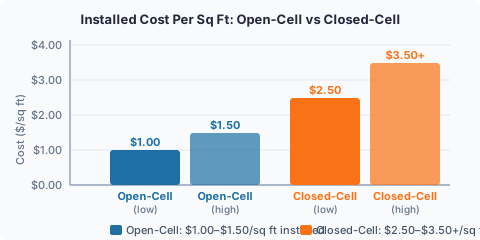
Why the gap? Raw material. Closed-cell foam uses HFO or HFC blowing agents that are more expensive to produce. It also requires more product per inch of R-value equivalent — you're paying for density. A 2-lb closed-cell product weighs four times more per cubic foot than 0.5-lb open-cell.
Here's a worked example. Say you have **1,200 square feet of attic rafter bays** to insulate. At 3.5 inches of closed-cell (roughly R-22.75):
- Material + labor: ~$2.80/sq ft × 1,200 = **$3,360 total**
The same job with 5.5 inches of open-cell (R-20.35):
- Material + labor: ~$1.25/sq ft × 1,200 = **$1,500 total**
Same-ish R-value. $1,860 price difference. That spread is real, and it's why foam type selection matters.
Spray Foam Cost by Application Type
Not every application bills the same way, even at identical square footage.
**Attics (rafter bay / roof deck application)** tend to be the most efficient. Open access, flat workflow, high square footage means lower labor per square foot. Expect the middle of the range for each foam type.
**Crawl spaces** often run 10–20% higher than attic work. Tight quarters, concrete surfaces, and awkward angles slow the crew down. Closed-cell is the dominant choice here because of moisture exposure, so budget accordingly.
**Rim joists and band joists** are priced by the linear foot or as a flat job rate because the area is small and the masking/prep work takes almost as long as the spray. A 2,000-sq-ft house perimeter might be 160 linear feet of rim joist — expect $600 to $1,400 for that line item alone.
**New construction walls** are the most cost-efficient scenario. The stud bays are fully open, no existing insulation to tear out, and the crew can move fast. Open-cell wall fill typically runs $0.90 to $1.20 per square foot of wall area.
Regional Labor Rate Differences
Materials ship anywhere, but labor doesn't. A spray foam crew in rural Alabama charges a different day rate than one in Boston or Seattle.
In the **South and Midwest**, labor rates tend to keep installed costs at the lower end of the range — $1.00 to $1.20 for open-cell, $2.50 to $2.80 for closed-cell.
In the **Northeast and Pacific Coast**, expect to add 25 to 40% to labor. The same 1,200-sq-ft attic job that costs $1,500 in Alabama might run $2,000 to $2,100 in Connecticut.
**Mountain West markets** (Denver, Salt Lake, Boise) sit in the middle — roughly 10 to 15% above Southern rates.
These aren't hard rules. A contractor who's slow or inefficient in a low-cost market can still overbid. [Run the numbers for your job](/spray-foam-insulation-cost-calculator) against regional benchmarks before you get quotes.
What's Included in a Spray Foam Quote?
A legitimate spray foam quote covers more than just squirting foam. Here's what should appear as line items — or at least be confirmed as included:
**Masking and prep.** Before foam goes on, everything that can't get sprayed must be covered. Electrical boxes, lighting fixtures, HVAC equipment, ductwork, and framing lumber that needs to stay exposed all get masked. This can be 30–60 minutes of a two-person crew's time.
**Equipment setup and breakdown.** The proportioner (the heated mixing unit), hoses, and spray guns need to be set to temperature before the first pass. For smaller jobs, this fixed overhead represents a larger percentage of total cost — one reason jobs under 500 sq ft carry higher per-square-foot prices.
**Material.** The A and B side chemical components. Quantity varies by thickness and foam density.
**Labor.** Typically billed hourly by crew size or factored into a per-square-foot rate.
**Travel and mobilization.** Many contractors charge a fuel or mobilization fee, especially for jobs outside their core service area. This can be $75 to $200.
**Cleanup.** Overspray happens. Cardboard, plastic sheeting, and disposal of empty chemical drums should be included.
What's typically *not* included: drywall repair after spray foam in walls, replacement of existing insulation that had to be removed first, or permits (if required in your jurisdiction).
Hidden Costs to Watch For
A few line items catch homeowners off guard.
**Existing insulation removal.** If you're retrofitting a vented attic with blown-in fiberglass and switching to a closed unvented assembly with spray foam, that old insulation has to come out first. Blown-in fiberglass removal runs $0.50 to $1.00 per square foot on its own.
**Mold or moisture remediation.** Any spray foam contractor worth hiring will inspect the substrate before spraying. If they find mold or active moisture, that needs to be addressed first. Skipping it will trap the problem under the foam permanently.
**Thermal barriers.** In most jurisdictions, spray foam in an occupied or semi-occupied space must be covered with a thermal barrier — typically 1/2-inch drywall. IRC Section R316 applies to most residential work. If your quote doesn't mention a thermal barrier for interior applications, ask.
**Re-spray for failed adhesion.** Low substrate temperature (below 40°F) causes poor adhesion and wrong cell structure. A crew that sprays anyway is setting you up for a callback. Make sure your contract specifies substrate temperature requirements.
How to Get the Best Price on Your Job
Getting three bids is table stakes. Getting *informed* bids takes a bit more work.
**Specify the thickness in your RFQ.** Don't ask for "spray foam in my attic." Ask for "3 inches of closed-cell on 1,800 sq ft of roof deck." Every contractor bidding the same scope means you're comparing apples to apples.
**Ask about yield.** Spray foam expands off-ratio when temperature or humidity is wrong. A contractor who can explain their off-ratio tolerance and quality control process is more trustworthy than one who just quotes a price.
**Look for SPFA membership or manufacturer certification.** The Spray Polyurethane Foam Alliance (SPFA) offers contractor training and credentialing. Icynene, Lapolla, BASF, and other manufacturers run their own certification programs. Certified applicators tend to produce fewer callbacks.
**Negotiate on mobilization, not materials.** If you want a discount, ask the contractor to reduce or waive the mobilization fee if you can combine your job with a neighbor's. Contractors love batching jobs in the same neighborhood.
**Don't price-shop on thickness.** A contractor quoting 2 inches of closed-cell is cheaper than one quoting 3 inches — but you're not getting the same product. [Calculate your spray foam costs](/spray-foam-insulation-cost-calculator) at the right thickness before you compare prices.
The [team at this site](/about) has seen homeowners save $400 to $800 on a mid-size job just by knowing the right questions to ask before bids come in.
Spray foam is one of those projects where the cheapest bid is often the most expensive outcome. A job done at the wrong temperature or wrong thickness costs you again in remediation. Know the numbers going in, spec the job clearly, and you'll get a fair price.