7 Spray Foam Mistakes That Cost Homeowners Thousands
Each of these spray foam mistakes has cost homeowners $500–$8,000 to fix. Here's how to spot them before the crew shows up — and what to ask your contractor.
Each mistake on this list has cost homeowners real money to fix. Some surface within weeks. Others don't show up until a home inspection before a sale, or when moisture damage finally spreads to the point where you notice it in the living space. Most are avoidable with the right questions asked before the job starts.
Here's what goes wrong with spray foam projects, what the warning signs look like, and how to protect yourself.
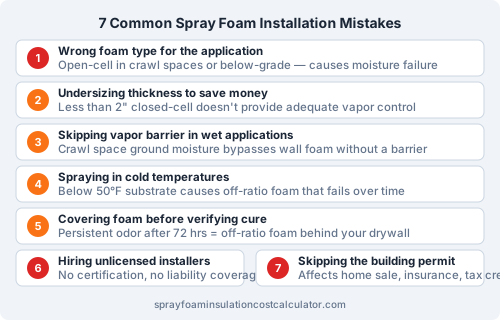
Mistake #1: Choosing the Wrong Foam Type for the Application
This is the most expensive error because it typically requires tear-out and reinstallation to correct. The fix cost runs $2,000–$8,000 depending on scope and how much moisture damage accumulated in the meantime.
Open-cell foam should never be used in crawl spaces, below-grade walls, or any application with direct moisture exposure. Open-cell foam at 0.5 lb density is vapor-permeable — water vapor passes through it freely. In contact with a moist concrete foundation wall or in a crawl space with any ground moisture, it will absorb moisture, sustain elevated wood moisture content in adjacent framing, and eventually support mold growth on the wooden substrate behind it.
Homeowners get quoted open-cell foam in crawl spaces regularly because it's 40–50% cheaper than closed-cell. Not every contractor explains what that price difference actually means for moisture performance.
The correct rule: closed-cell foam in any moisture-prone location. That means:
- Crawl space foundation walls and rim joists
- Basement walls at or below grade
- Exterior walls in Climate Zones 5–8
- Any application with regular or occasional water exposure
Open-cell is appropriate for interior wall cavities, conditioned attic rafter bays in warm climates, and soundproofing applications. Ask your contractor to explain why they chose the foam type before you sign anything.
Mistake #2: Undersizing Thickness to Save Money
This mistake costs less up front and more over time. Under-applied foam misses both the R-value target and — critically — the vapor control function that adequate thickness provides.
Closed-cell foam's vapor permeance is directly tied to thickness:
- **1 inch:** ~3 perms (Class III vapor retarder — inadequate for most cold-climate applications)
- **2 inches:** ~0.5–0.8 perms (Class II — acceptable for most applications)
- **3 inches:** ~0.1 perms (near Class I — vapor barrier level)
A homeowner who asks a contractor to spray 1.5 inches instead of 2.5 inches to save $400 on a 500 sq ft job may have installed insulation that doesn't function as a vapor retarder — meaning moisture drive continues through the wall or foundation, and the insulation upgrade doesn't solve the moisture problem it was supposed to address.
**For attic applications:** DOE recommendations for Climate Zone 5 specify R-49 to R-60. That's 7.5–9 inches of closed-cell or 13–16 inches of open-cell. A quote for 4 inches of closed-cell (R-26) is leaving 35–50% of the potential performance unrealized.
[Plug in your area and foam type](/spray-foam-insulation-cost-calculator) to check what thickness is standard for your climate zone before agreeing to a specification.
Mistake #3: Skipping the Vapor Barrier in Wet Conditions
Spray foam on crawl space walls handles vapor drive through those walls. It doesn't address the second major moisture source: water evaporating upward from the ground.
An unprotected dirt or gravel floor in a crawl space can maintain 80–90% relative humidity in the space year-round, regardless of how well the walls are insulated. That moisture reaches the floor joists above, keeps wood moisture content elevated, and undermines the entire insulation investment.
The correct assembly for a conditioned crawl space is:
- Closed-cell foam on foundation walls and rim joists
- 6-mil minimum vapor barrier on the entire floor, lapped up the walls 6 inches and sealed
- Foundation vents sealed or blocked
- Small HVAC supply or dehumidifier to condition the space
Some contractors quote wall foam only and list the vapor barrier as a separate add-on. Make sure you know exactly what's in the quote scope. A proper 20-mil reinforced vapor barrier for a 1,500 sq ft crawl space adds $750–$1,350 to the project — money that makes the wall foam actually work.
For full detail on crawl space encapsulation, the [spray foam crawl space guide](/spray-foam-crawl-space) covers the right assembly from foundation to floor.
Mistake #4: Not Getting the Temperature Right During Application
Spray polyurethane foam chemistry is temperature-sensitive at every stage. The SPFA recommends:
- **Substrate temperature:** 50°F minimum; 60°F+ is better
- **Ambient air:** 40–100°F during application
- **Chemical component temperature at the gun:** 70–85°F
When the A and B components are too cold, they don't react at the correct rate. The resulting off-ratio foam looks normal during application but has weaker cell structure, lower R-value, and reduced adhesion. It becomes brittle over time and can crumble or delaminate within 3–5 years. There's no easy way to detect off-ratio foam by visual inspection — it looks like properly cured foam until it starts to fail.
This is a real-world problem because contractors face scheduling pressure and sometimes spray in suboptimal conditions to keep projects on track. A crew spraying a January attic in Minnesota where the substrate is 38°F and they haven't given the equipment time to warm the chemicals — that's off-ratio foam waiting to happen.
Before hiring: ask the contractor what their minimum substrate temperature policy is. A good contractor has a clear answer. If you get vague reassurance instead of a specific number, that's a warning sign.
Mistake #5: Covering Foam That Fails the Sniff Test
Properly cured spray foam has no discernible odor 48–72 hours after application. A chemical smell — often described as fishy, ammoniacal, or sharply organic — that persists beyond 72 hours is a reliable sign of off-ratio foam.
Off-ratio foam off-gasses amine compounds for weeks or months. These are indoor air quality contaminants. The fix is removal and reinstallation, which typically costs $1,500–$4,000 depending on scope — plus the drywall, finishing, and painting that covered it.
The mistake is drywalling or otherwise covering foam before confirming it has cured correctly. Once it's behind gypsum board, you won't know there's a problem until the smell bleeds through — at which point you've paid to install and then remove finish materials.
Standard practice after any spray foam job:
1. Ventilate the space for 24–48 hours before anyone re-enters
2. Return at 72 hours and do a smell check — the foam should be odorless
3. If you detect any chemical smell at 72 hours, don't cover the foam
4. Contact the contractor immediately; off-ratio foam is their liability
Don't let a contractor talk you into covering foam quickly to "keep the project moving." The 72-hour wait costs nothing and protects both you and them.
Mistake #6: Hiring Unlicensed Installers
Professional spray foam installation requires a heated proportioner — a machine that maintains precise temperature and pressure on both chemical streams — calibrated spray guns, and trained operators who understand how to adjust for ambient conditions. This is not equipment or knowledge that comes from watching a YouTube video.
DIY kits work well for small, defined jobs: rim joist sealing under 300 sq ft, pipe and wire penetrations, small patches. See the [DIY spray foam guide](/diy-spray-foam-insulation) for the cases where kits make sense and where they don't.
For full-scale installations, hiring an unlicensed or uninsured installer creates several risks:
- Off-ratio foam from improperly calibrated equipment (and no recourse)
- No liability insurance if the work causes property damage
- No workers' comp if a worker is injured on your property
- Non-permitted work that surfaces as a defect at home sale
Verify your contractor is certified through the SPFA Contractor Certification Program or holds a state-issued applicator license (required in some states). Ask for a certificate of insurance naming you as additionally insured for the project. A legitimate contractor produces this documentation without pushback.
Mistake #7: Skipping the Building Permit
Spray foam insulation work on conditioned crawl spaces, roof deck applications, and whole-building thermal envelope changes typically requires a building permit. The permit fee is $200–$500. The cost of not pulling one can be much higher.
**At home sale:** Unpermitted work that changes the building's thermal envelope is a material defect in most states. Buyers' inspectors flag it. You may need to retroactively permit and inspect the work — which means opening walls or ceilings to allow inspection — or take a price reduction.
**For insurance claims:** Some insurers deny moisture damage or structural claims when unpermitted work contributed to the conditions. If your crawl space encapsulation was never permitted, inspected, or verified code-compliant, and you have a mold claim later, you may be on your own.
**For the IRA tax credit:** Section 25C requires that installation meets applicable energy codes. Work done without a permit can't be verified as code-compliant by an independent inspector. This may disqualify your credit claim if audited. See the [spray foam tax credits guide](/spray-foam-tax-credits) for full details on qualification requirements.
The permit process also gives you a building inspector who will verify the foam meets R-value specs, fire code (IRC R316 thermal barrier requirement), and installation quality standards. That independent verification is worth more than the hassle of pulling the permit.
---
The best protection against all seven of these mistakes is preparation. [Estimate your project cost](/spray-foam-insulation-cost-calculator) before the first contractor walks in — knowing the fair price range for your area makes it immediately obvious when a bid is suspiciously low. A quote 30% below market almost always means something above has been compromised.
For full cost context, the [spray foam insulation cost guide](/spray-foam-insulation-cost-guide) breaks down pricing by application type and foam type.
For more about how we build and verify the cost data behind the calculator, see our [about page](/about).