Spray Foam R-Value Guide: How Much Is Enough?
R-value determines how well your insulation works — and how much you spend. Here's what the DOE recommends by climate zone and application.
Pick the wrong R-value target and you either freeze your budget on unnecessary thickness or leave real energy savings on the table. The foam brand rarely matters. Getting R-value right for your climate zone and application type is what actually moves the needle on your energy bills.
What R-Value Means (and What It Doesn't)
R-value measures thermal resistance — how much a material resists heat flowing through it. Higher is better at preventing heat transfer. An R-30 attic resists heat flow roughly twice as well as an R-15 attic.
What R-value doesn't measure: air leakage. This is where spray foam outperforms every other insulation type, and it's worth understanding. A fiberglass batt rated at R-19 can perform like R-10 or worse in a drafty wall because air moves through the batt and around it. Spray foam fills every gap, so the rated R-value is close to the real-world performance.
That air-sealing bonus doesn't show up in the R-value number, but it absolutely shows up in your heating and cooling bills. The Department of Energy estimates that air leakage accounts for 25 to 40% of the heating and cooling energy used in a typical home.
R-value is a useful metric. Just remember it's part of the story, not the whole thing.
Open-Cell and Closed-Cell R-Values Per Inch
The numbers here matter for calculating thickness requirements.
**Open-cell spray foam:** approximately **R-3.7 per inch**. Some products hit R-3.8 depending on formulation. ASTM C518 test results for common open-cell products cluster tightly around this value.
**Closed-cell spray foam:** approximately **R-6.0 to R-6.5 per inch**. The IRC Section R402 uses R-6.0 per inch as the minimum recognized value for closed-cell products. Premium formulations (Lapolla FoamLok 2000-4G, BASF Walltite) test closer to R-6.5 per inch.
To hit a target R-value, you can calculate required thickness directly:
**Required inches = Target R-value ÷ R-value per inch**
For example, targeting R-38 in a cold-climate attic:
- Open-cell: 38 ÷ 3.7 = **10.3 inches**
- Closed-cell: 38 ÷ 6.5 = **5.8 inches** (round up to 6 inches)
That thickness difference drives cost. [Calculate your spray foam costs](/spray-foam-insulation-cost-calculator) at the thickness you actually need before comparing quotes.
DOE R-Value Recommendations by Climate Zone
The Department of Energy divides the US into eight climate zones, with higher zones requiring more insulation. The zones you'll encounter most in residential work:
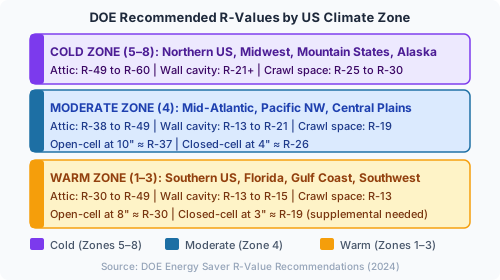
**Zones 1–3 (Warm: Florida, Gulf Coast, Southwest, Southern California)**
- Attic: R-30 to R-49
- Walls (cavity only): R-13 to R-15
- Crawl space: R-13 minimum
**Zone 4 (Moderate: Mid-Atlantic, Pacific Northwest, Central Plains)**
- Attic: R-38 to R-49
- Walls (cavity): R-13 to R-21
- Crawl space: R-19
**Zones 5–6 (Cold: Midwest, Northeast, Mountain States)**
- Attic: R-49 to R-60
- Walls (cavity): R-21 minimum; continuous insulation additional
- Crawl space: R-25 to R-30
**Zones 7–8 (Very Cold/Subarctic: Northern Minnesota, Montana, Alaska)**
- Attic: R-60 or more
- Walls: R-21 cavity + R-5 continuous exterior minimum
- Crawl space: R-30
These are DOE Energy Saver program recommendations based on energy modeling, not code minimums. Local code (typically based on IECC 2021) may differ slightly. Always verify with your local AHJ.
R-Value Requirements for Attics vs Walls vs Crawl Spaces
Each application type has different dynamics, and hitting the same number means something different in each location.
**Attics** carry the highest R-value targets because attics are the biggest thermal weak point in most homes. Heat rises into the attic in winter and radiates down through it in summer. Most energy codes now require R-49 or higher for attic assemblies in Zones 4 and above.
With spray foam applied to the roof deck (unvented attic assembly), you're insulating the roof deck rather than the floor. That means the full R-value target must be achieved with foam thickness alone. At closed-cell R-6.5/inch, hitting R-49 requires 7.5 inches. At open-cell R-3.7/inch, you need 13.2 inches.
**Walls** have less depth to work with. A standard 2×6 stud bay gives you 5.5 inches maximum. Open-cell fills it completely for R-20.3. Closed-cell at 3 inches hits R-19.5, leaving 2.5 inches of air space — which actually costs nothing and provides a small additional buffer.
Some builders in cold climates specify a hybrid wall: 1 inch of closed-cell (R-6.5) against the exterior sheathing for vapor control, then fill the remaining 4.5 inches with open-cell (R-16.6) for a total wall assembly R-value over R-23. That's solid performance at a lower cost than full-depth closed-cell.
**Crawl spaces** are often under-insulated because they're out of sight. The DOE recommends insulating the crawl space walls rather than the floor above in an unvented crawl space assembly — this brings the crawl space into the conditioned envelope, protects pipes, and improves HVAC efficiency. Closed-cell at 2 to 3 inches on the walls (R-13 to R-19.5) meets most code requirements.
When More R-Value Isn't Worth the Extra Cost
There's a law of diminishing returns in insulation, and spray foam doesn't escape it.
Going from R-0 to R-19 in an attic makes a dramatic difference in energy use — you're filling a massive thermal gap. Going from R-49 to R-60 makes a much smaller difference in dollar terms relative to the material cost.
Building scientists call this the "R-value sweet spot." Oak Ridge National Laboratory research shows that for most climate zones, returns on additional attic insulation diminish significantly past R-49. The incremental savings from R-49 to R-60 might be $20 to $40 per year — and the extra 2 to 3 inches of foam might cost $800 to $1,200 more on a 1,500-sq-ft attic.
Similarly, walls beyond R-21 in Climate Zone 5 offer minimal returns. A 2×6 wall fully filled with closed-cell (R-33) costs roughly twice what an open-cell filled wall (R-20) costs, and the energy savings difference is typically under $50 per year.
The exception: extremely cold climates (Zone 7–8), high-performance home specifications (Passive House targets R-60+ walls), and commercial applications with long payback horizons.
How Thickness Affects Your Total Project Cost
R-value and thickness are inseparable, and thickness drives material cost directly.
Spray foam is sold in board-feet — one board-foot is 1 square foot at 1 inch thick. Doubling thickness doubles material cost, roughly. So a job that calls for 3 inches costs about half as much in material as the same job at 6 inches.
Here's a worked example for **1,500 sq ft of open-cell in an attic**, comparing two thickness targets:
**Target R-30 (8.1 inches, round to 8"):**
- Board-feet: 1,500 × 8 = 12,000 board-feet
- Installed cost at $0.44/board-ft: ~**$5,280**
**Target R-49 (13.2 inches, round to 13"):**
- Board-feet: 1,500 × 13 = 19,500 board-feet
- Installed cost at $0.44/board-ft: ~**$8,580**
The jump from R-30 to R-49 costs an extra $3,300. Whether that's worth it depends on your climate zone and expected energy savings. In Zone 5 or 6, R-49 is the right call. In Zone 2, R-30 meets code and the extra spend likely won't pay back in a reasonable timeframe.
[Run the numbers for your job](/spray-foam-insulation-cost-calculator) — you can model different thicknesses and see the cost difference instantly before talking to a contractor.
For a deeper look at how open-cell and closed-cell compare on every metric beyond R-value, see our [comparison of the two foam types](/open-cell-vs-closed-cell-spray-foam). And if you're specifically planning an attic project, the [spray foam attic insulation guide](/spray-foam-attic-insulation) covers assembly choices and thickness requirements in detail.
The [team behind this calculator](/about) builds these tools to help homeowners walk into contractor conversations with real numbers. R-value targets aren't magic — they're engineering decisions. Know what you need before someone sells you more than you do.