Spray Foam Tax Credits 2026 (IRA Section 25C)
The IRA Section 25C credit covers 30% of spray foam material costs, up to $1,200 per year. Here's exactly who qualifies, which foam types count, and how to file.
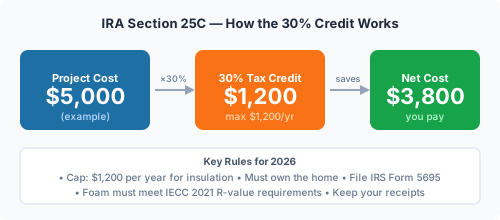
The Inflation Reduction Act's Section 25C credit is one of the most straightforward energy tax benefits available to homeowners right now. Install qualifying spray foam insulation, keep your receipts, file IRS Form 5695 — and you get 30% of material costs back as a direct tax credit, not a deduction.
For a $5,000 install with $2,800 in materials, that's $840 directly off your tax bill. For a $6,500 job with $4,000+ in materials, you hit the $1,200 annual cap and that's what you get. Before scheduling any work, [run the numbers for your job](/spray-foam-insulation-cost-calculator) so you know your baseline cost and how much of it qualifies.
What Is the IRA Section 25C Tax Credit?
Section 25C has existed in the tax code since 2005, but the Inflation Reduction Act rewrote the rules for tax years 2023 through 2032. The old version was a lifetime credit capped at $500. The new version resets every year.
Here's what matters for a 2026 install:
- **Credit rate:** 30% of the cost of qualifying materials
- **Annual cap:** $1,200 combined for insulation and air-sealing improvements
- **Eligible property:** Your principal residence — the home where you actually live
- **Who files:** The homeowner of record; renters don't qualify
- **Credit type:** Nonrefundable — it reduces what you owe, but you can't receive more back than your tax liability
That nonrefundable detail trips people up. If your total federal tax bill for 2026 is $900 but your credit calculates to $1,200, you receive $900 off your taxes. The remaining $300 is gone — you can't carry it forward under current law.
One important update for 2026: the credit structure established by the IRA remains in effect through 2032 unless Congress changes it. There's no scheduled phase-down or sunset within that window. You can plan around it.
How Much Can You Claim for Spray Foam?
The 30% rate applies to **material costs only**. Contractor labor, equipment rental, mobilization fees, and cleanup charges don't count.
This matters more than most homeowners realize. A contractor invoice that shows a single total price — say, $6,000 for an attic spray foam job — doesn't automatically mean you can claim 30% of $6,000. The IRS expects you to know the material portion.
Ask your contractor to provide an itemized invoice that separates:
- Materials (foam chemicals, primer if applicable)
- Labor
- Any other line items
Most legitimate contractors will do this without pushback. If you get resistance, that's itself a red flag about the contractor's paperwork habits.
**Worked calculation:** Contractor charges $5,000. Invoice shows $2,800 materials, $2,200 labor.
- Qualifying amount: $2,800
- Credit: $2,800 × 30% = **$840**
For jobs where materials exceed $4,000, you hit the cap: $4,000 × 30% = $1,200. Any materials above that threshold produce no additional credit within a single tax year.
**Splitting projects across years:** If you're planning an attic job AND a crawl space job, consider staging them in separate calendar years. You can claim up to $1,200 per year. Two $4,000-material jobs in 2026 and 2027 nets you $2,400 total in credits. The same two jobs completed in 2026 alone nets you $1,200.
Which Foam Types Qualify?
The product must meet or exceed the R-value requirements of the International Energy Conservation Code (IECC) in effect at the time of installation, or have a Manufacturer's Certification Statement confirming it meets those thresholds for your climate zone.
**Closed-cell spray foam** at R-6.5 per inch qualifies easily in virtually every climate zone when installed at code-minimum thickness. A 2-inch install delivers R-13; a 3-inch install delivers R-19.5. Both exceed typical continuous insulation minimums.
**Open-cell spray foam** at R-3.7 per inch can qualify, but the math is tighter. In Climate Zone 5 (most of the Midwest), the IECC requires R-13 continuous insulation. Getting there with open-cell needs 3.5 inches. At 2 inches (R-7.4), it likely won't qualify. Your contractor should know whether the proposed application meets IECC requirements for your zone.
**What you need from your contractor:**
1. A Manufacturer's Certification Statement for the specific product used — not a generic one for the brand family
2. The product's listed R-value per inch
3. Confirmation of installed thickness
The IRS doesn't require you to attach these documents to your return. But you need to keep them in case of audit — store them with your tax records for at least 3 years after filing.
How to Claim the Credit on Your Taxes
File **IRS Form 5695** — "Residential Energy Credits." It's the same form used for solar and geothermal credits, but Section 25C (insulation) is in Part II.
Steps to file:
1. Gather receipts showing material costs (itemized)
2. Get the manufacturer's certification statement
3. Complete Form 5695, Part II (Energy Efficient Home Improvement Credit)
4. Your calculated credit flows to Schedule 3, Line 5, and from there to Form 1040
5. File by the normal deadline (April 15, 2027 for tax year 2026)
If you use tax software, there's a guided section for energy credits. TurboTax, H&R Block, and FreeTaxUSA all handle Form 5695 without add-ons. The process takes 10 minutes if you have your invoice in hand.
One timing note: the credit applies to the tax year when **payment is made**, not when work is contracted or scheduled. If you sign a contract in December 2026 and pay a deposit, claim what you paid in 2026. The balance paid in January 2027 is a 2027 credit.
State Rebates That Stack with the Federal Credit
The Section 25C credit is federal, but multiple other programs can layer on top of it.
**IRA HOMES Rebates (Section 50121):** The DOE allocated $4.3 billion to states to fund direct rebates for energy efficiency upgrades. These are administered by state energy offices and are rolling out on different timelines. Some states are offering $1,600–$4,000 in direct-pay rebates for insulation improvements — no tax liability required to collect them.
**Utility company rebates:** Duke Energy, Xcel Energy, National Grid, Consumers Energy, and many others offer insulation rebates ranging from $0.10 to $0.30 per square foot. A 1,500 sq ft attic job at $0.20/sq ft is $300 back. Check your utility's website or DSIRE (Database of State Incentives for Renewables & Efficiency) at dsireusa.org.
**State income tax credits:** Maryland, Oregon, New York, and a handful of other states have their own efficiency credits. These apply separately from Section 25C and don't reduce your federal credit calculation.
**Stacking example:** $5,000 project with $3,000 in materials:
- Federal 25C credit: $3,000 × 30% = **$900**
- State utility rebate: 1,000 sq ft × $0.20 = **$200**
- State income tax credit (where applicable): **$150**
- **Total incentives: $1,250**
- **Net cost: $3,750**
These don't interact negatively unless you receive a government grant or rebate that fully reimburses your material cost — in that case, you must subtract the reimbursed amount from your qualifying base before calculating the 25C credit.
For long-term payback context, the [spray foam lifespan guide](/how-long-spray-foam-lasts) covers how durable the product is and when the energy savings break even.
Common Mistakes That Disqualify Your Claim
**Claiming labor costs.** 30% of labor is not eligible. Overclaiming is an audit risk. Get the itemized invoice and only enter material costs into Form 5695.
**Insulating a rental or vacation property.** Section 25C covers your principal residence only. A second home, rental unit, or investment property doesn't qualify regardless of how often you're there.
**Missing the manufacturer certification.** The IRS won't chase you for it at filing, but if you're audited and can't produce it, the credit gets disallowed. Get the document before the contractor's truck leaves your driveway.
**Confusing 25C with 25D.** Section 25D covers solar panels and geothermal heat pumps with no annual cap. Section 25C is the one for insulation, windows, and HVAC. They're on the same Form 5695 but in different parts. Make sure your claim lands in Part II.
**Double-dipping with HOMES rebates.** If you received a direct rebate through a state HOMES program, you need to subtract that rebate from your qualifying cost before computing the 25C credit. The IRS specifically disallows claiming a tax benefit on expenses already reimbursed by a government program.
**Filing in the wrong year.** The credit goes on the return for the year you paid, not the year the work was done. If the contractor was paid in installments across two tax years, split the credit accordingly.
[Calculate your spray foam costs](/spray-foam-insulation-cost-calculator) before the install date. Knowing your projected material total helps you decide whether to expand scope and hit the $1,200 cap this year, or stage work for maximum credit across multiple years.
For more on qualifying spray foam applications, the [attic insulation guide](/spray-foam-attic-insulation) covers the specific R-value thresholds by climate zone.
Make the Credit Work for You
The Section 25C credit is money sitting on the table. A $5,000 spray foam job with $3,000 in materials costs you $4,100 after the credit — not $5,000. That's real.
Get the itemized invoice. Get the manufacturer certification statement. File Form 5695. It's not complicated; it's just paperwork that most homeowners skip because they don't know to ask.
If your project is large enough that materials will exceed $4,000, talk to your tax advisor about staging payment into two calendar years to claim $1,200 both years. And check your state energy office for HOMES rebates before your install — that money doesn't require any tax liability to collect.
For more about how this site works and who's behind the calculator, visit our [about page](/about).