Spray Foam vs Fiberglass: Cost & Performance
Fiberglass costs $0.30–$0.80 per sq ft. Spray foam costs $1.00–$3.50. The difference in long-term savings often closes that gap — here's how.
Fiberglass batts are cheap at installation time. That's the beginning and end of their case. Spray foam costs two to five times more upfront — but it seals air, resists moisture, and doesn't sag or settle over time. Whether that premium pays off depends on your home, your climate, and how long you plan to stay there.
Let's look at both products honestly, with real numbers.
Side-by-Side Performance Comparison
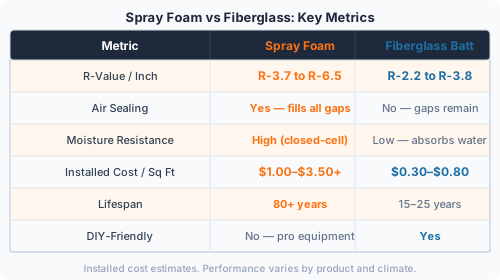
The table above summarizes the key differences, but the numbers need context.
**R-value per inch** is where the gap is obvious: closed-cell spray foam delivers R-6.0 to R-6.5 per inch versus R-2.2 to R-3.8 for fiberglass batts (loose-fill fiberglass runs R-2.2 to R-2.7; high-density batts like Owens Corning EcoTouch reach R-3.8). That matters when you're depth-limited — a 2×4 wall at 3.5 inches gives you R-13 with standard fiberglass or R-15 with high-density batt, versus R-22.75 with closed-cell foam.
**Lifespan** is often overlooked. Fiberglass batts are typically warranted for 20 to 25 years. They lose some performance as they settle and as air infiltration degrades effective R-value. Spray foam has no meaningful degradation timeline — properly installed closed-cell foam tested at 20+ years shows minimal R-value loss. Most manufacturers offer lifetime product warranties.
**Moisture resistance** is fiberglass's biggest weakness. Fiberglass absorbs water and loses R-value when wet — a batt at 70% moisture content can drop to near R-0 effective performance. It also supports mold growth when wet. Closed-cell spray foam is inert to moisture and won't harbor mold. Open-cell foam absorbs water but dries back out — still a better performer than fiberglass in most wet scenarios.
The Air Sealing Advantage of Spray Foam
This is the single most important difference between the two products, and it doesn't show up in any R-value chart.
Fiberglass batts do not air-seal. They're permeable — air moves through them and around them. A 2×6 wall cavity with an R-19 batt still has air moving around the batt's edges, through electrical box cutouts, and through imperfect fit at framing. ORNL (Oak Ridge National Laboratory) research measured that air infiltration through batt-insulated wall assemblies can reduce effective R-value by 25 to 50%.
Spray foam expands into every gap, corner, and void. It seals at the point of air infiltration — not at the interior gypsum layer where caulk tries to play catch-up. A spray foam installation essentially wraps the framing in a continuous air barrier.
The DOE estimates that air sealing + insulation combined typically reduces heating and cooling costs by 15 to 25% in existing homes. Insulation alone (without air sealing) captures maybe half that benefit. That's the gap you're paying for with spray foam.
Real Cost Comparison: 2,000 Sq Ft Home
Here's a concrete worked example — a 2,000-sq-ft single-story home in Climate Zone 4, with 2×6 exterior walls (600 linear feet perimeter × 9-foot ceiling = 2,700 sq ft of wall area after windows/doors) and a 2,000-sq-ft vented attic floor.
**Fiberglass batts — full insulation:**
| Area | Product | Cost/sq ft | Total |
|------|---------|-----------|-------|
| Walls (2,700 sq ft) | R-21 high-density batt | $0.65 | $1,755 |
| Attic floor (2,000 sq ft) | R-38 blown-in fiberglass | $0.55 | $1,100 |
| **Total** | | | **$2,855** |
Add $400 to $600 for professional air sealing (caulk, foam in a can, weatherstripping) if you want to capture air-leakage savings separately.
**Spray foam — full insulation:**
| Area | Product | Cost/sq ft | Total |
|------|---------|-----------|-------|
| Walls (2,700 sq ft) | Open-cell 5.5" (R-20) | $1.20 | $3,240 |
| Attic roof deck (2,200 sq ft) | Open-cell 10" (R-37) | $1.35 | $2,970 |
| **Total** | | | **$6,210** |
The spray foam job costs **$3,355 more upfront**. Average annual energy savings from air sealing + upgraded insulation in a Zone 4 home: $350 to $600 per year (EIA residential energy data, 2024). Payback period: **6 to 10 years**.
If you're staying in the home 10+ years, spray foam is the financially stronger choice. If you're selling in 3 years, fiberglass is rational.
[Get a free estimate](/spray-foam-insulation-cost-calculator) for your specific square footage and foam type to run your own payback calculation.
When Fiberglass Batts Are the Right Choice
Fiberglass isn't obsolete — it's appropriate in specific situations.
**Budget-constrained new construction in mild climates.** In Climate Zones 1 and 2 with moderate humidity, the air leakage penalty is smaller and the energy cost savings from spray foam are lower. The payback on spray foam premium may extend beyond 15 years, making fiberglass the better economic choice.
**Renovations with tight timelines.** Spray foam requires the space to be unoccupied during installation and for 24 hours of cure time (longer for full off-gassing). For a fast flip or occupied renovation, fiberglass can be installed and covered same-day.
**Interior partition walls for sound.** Acoustic fiberglass batts (like Rockwool Safe'n'Sound or Johns Manville Formaldehyde-Free) outperform spray foam for sound attenuation in interior partition walls where air sealing and moisture aren't concerns. The cost is lower, and the acoustic performance is better.
**Attic floors in climate zones 1–3.** If you're staying with a vented attic assembly and just need R-30 on the floor, blown-in fiberglass at $0.50 to $0.65 per sq ft is hard to beat economically. You don't need spray foam's air-sealing properties on a fully vented attic floor.
When to Upgrade to Spray Foam
Spray foam makes the most sense in these scenarios:
**Any below-grade application.** Foundation walls, crawl space walls, below-slab insulation — fiberglass will eventually fail in a wet environment. Closed-cell spray foam is the correct product here, full stop.
**Rim joists.** The band joist where the floor framing meets the foundation wall is one of the biggest air leakage points in older homes. It's also too small and awkward for fiberglass batts to fit correctly. Closed-cell spray foam at 2 to 3 inches fills the rim joist cavity completely, seals every gap, and adds R-13 to R-19.5 in a space that typically has no insulation at all. Cost for a 2,000-sq-ft house: $400 to $900 — almost always worth it.
**Existing homes with high air leakage.** If your blower door test shows ACH50 above 8.0, you have a significant air sealing problem that insulation won't fix. Spray foam in the attic and crawl space is the most effective retrofit approach.
**High-performance builds (LEED, Passive House, Energy Star).** These programs require air changes per hour (ACH50) below 3.0 or 1.0, levels that can't be achieved with batt insulation alone. Spray foam is standard practice in certified high-performance construction.
Hybrid Approaches: Using Both Together
You don't have to choose one product for the entire house. The most cost-effective insulation system for many homes uses both.
**The most common hybrid approach:**
- Spray foam (open-cell or closed-cell) in the attic at the roof deck — highest priority location for air sealing and R-value
- Spray foam (closed-cell, 2 inches) at rim joists — quick win, high ROI
- Spray foam (closed-cell, 2–3 inches) at crawl space walls if applicable
- Fiberglass batts in above-grade walls — lower priority, more depth, easier access
This prioritizes spray foam where air leakage and moisture matter most, uses lower-cost fiberglass where the risk is lower, and typically hits 80% of spray foam's energy performance at 50 to 60% of spray foam's total cost.
**Flash-and-batt walls** are a formal hybrid technique: a thin layer (1 to 2 inches) of closed-cell spray foam is applied directly to the sheathing interior face, providing vapor control and air barrier function, then standard fiberglass batts fill the remaining cavity depth. The result is an air-sealed wall assembly at a lower cost than full-depth spray foam. This approach is detailed in ASHRAE 90.1 and is common in commercial construction.
The [spray foam cost guide](/spray-foam-insulation-cost-guide) has more detail on pricing across all application types. For a closer look at the two spray foam types themselves, the [open-cell vs closed-cell comparison](/open-cell-vs-closed-cell-spray-foam) covers performance in depth.
[Plug in your area and foam type](/spray-foam-insulation-cost-calculator) to price out your specific project — whether that's all spray foam, a hybrid approach, or just targeting the highest-ROI locations first.
The [team behind this tool](/about) believes the best insulation system is the one that fits your budget and climate, not the most expensive one. Know the numbers, prioritize the right locations, and you'll make a good call either way.